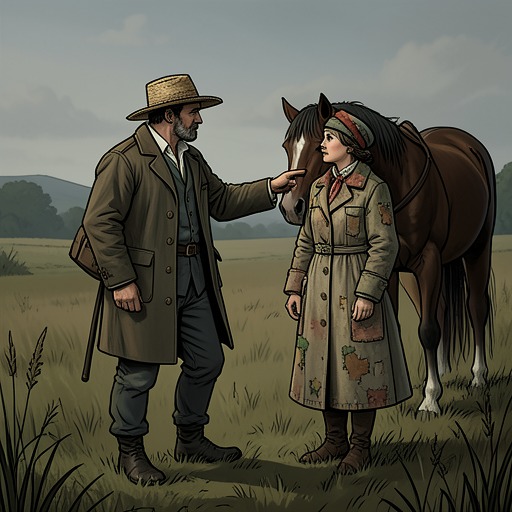
Black Beauty’s Breaking-In
Black BeautyBlack Beauty’s Breaking-In marks the change from a young horse kept from adult work until he is grown to one prepared for riding and harness. Its decisive feature is the method: his master takes responsibility for the training and introduces each new demand gradually, making trust and familiarity part of the work rather than relying on force. The account’s railway exercise extends that care beyond equipment and obedience, teaching Black Beauty to meet a startling noise without lasting fear.
Age, appearance, and the decision to train
By the time the training begins, Black Beauty has grown handsome, with a fine, soft, bright-black coat, one white foot, and a white star on his forehead. His master has refused to sell him before he is four, reasoning that young horses should not be expected to work before they are fully grown. The delay sets the tone for the episode: readiness is treated as a matter of development, not simply an opportunity to put a horse to use.
When Black Beauty reaches four, Squire Gordon examines his eyes, mouth, and legs, then watches him walk, trot, and gallop. He considers the horse promising, provided he is well broken in. Black Beauty’s master undertakes the training himself, explaining that he does not want the young horse frightened or hurt, and begins the next day. The choice matters because the process will bring Black Beauty into close contact with unfamiliar restraints and work; the person directing it already recognizes that how he learns is consequential.
What breaking in requires
Black Beauty describes breaking in as a wide-ranging education, not simply the first time a rider mounts. A horse must learn to wear saddle and bridle, carry a person, respond to directions, and stand quietly while a collar, crupper, and breeching are fitted. He must also learn to pull a cart or chaise and alter his pace according to the driver. The training imposes expectations on movement and conduct: the horse is not to start at what he sees, bite, kick, or act according to his own will, even when tired or hungry. Once harnessed, he cannot freely jump for joy or lie down from weariness. The account makes the asymmetry of the arrangement explicit: the horse is being taught to adapt his body and behavior to human purposes.
The first unfamiliar equipment is the bit and bridle. Black Beauty is accustomed to a halter and headstall, but the bit is uncomfortable to him. His master offers oats and uses coaxing, pats, kind words, and gentle handling; with these reassurances, Black Beauty accepts the bridle. The episode does not present acceptance as immediate or effortless. It follows discomfort with patient introduction, and shows the young horse learning to tolerate the equipment through repeated, reassuring contact.
Saddle, shoes, and harness
The saddle follows. Old Daniel holds Black Beauty’s head while his master places the saddle gently, fastens the girths, and continues patting and talking to him. The routine is repeated every day, with oats and short periods of leading. In time, Black Beauty begins to anticipate the food and saddle. One morning his master rides him around a meadow on soft grass. The sensation is strange, but Black Beauty also feels proud to carry his master; as the rides continue a little each day, he becomes accustomed to them. Repetition turns a new demand into a familiar one without erasing the horse’s own response to it.
Learning to wear iron shoes is another adjustment. His master accompanies him to the smith’s forge to make sure he is not frightened or hurt. The blacksmith trims his hooves and fits the shoes with nails. Black Beauty’s feet initially feel stiff and heavy, but he gradually gets used to them. The master’s presence at the forge is consistent with his role throughout this training: he does not leave the young horse alone with an unfamiliar procedure, but stays to oversee it.
Harness brings a further set of sensations. Black Beauty must wear a stiff collar, a bridle with Blinkers that restrict his sideways view, and a small saddle with a crupper passing beneath his tail. He particularly dislikes the crupper and feels an impulse to kick, but does not act against a master he trusts. In time, he adjusts to the equipment and can do his work as well as his mother. The sequence distinguishes becoming capable from finding every part of the work comfortable: adaptation comes through gradual experience, under kind handling.
Learning not to fear the railway
The training also includes a fortnight at a neighboring farmer’s meadow beside a railway. Black Beauty is turned out among sheep and cows, and encounters a train while quietly feeding near the boundary. The first passing train frightens him; he gallops to the far side of the meadow and remains alarmed. Trains continue to pass, and some stop at a nearby station with loud noises. For the first few days he cannot feed peacefully.
His fear eases as he observes that the train does not enter the field or harm him. He begins to ignore it, eventually becoming as unconcerned by passing trains as the sheep and cows. The lesson depends on experience: the threatening appearance and noise remain, but repeated harmless encounters change what they mean to him. Black Beauty later contrasts his own ease at railway stations with the alarm and restlessness he has seen in other horses, and credits his master’s care for the difference.
Outcome and significance
The episode closes by presenting the method as an example for anyone training a young horse well. Its steps—waiting until Black Beauty is four, introducing equipment in stages, repeating the saddle routine with oats and reassurance, supervising the shoeing, and allowing time to become familiar with trains—show practical preparation joined to attention to fear and comfort. The account does not suggest that training removes every constraint: the horse is still expected to carry people, pull vehicles, and obey a driver. Instead, it distinguishes humane instruction from needless fright and shows that patient preparation can produce a horse able to work with confidence.
Black Beauty’s mother, Duchess, also gives him counsel for the uncertain life of a horse. She advises him to do his best for his master, while warning that horses may encounter thoughtful people, cruel people, or careless and ignorant ones. The advice places his gentle training within a larger uncertainty: good beginnings matter, but a horse cannot choose who may eventually buy or drive him. His breaking-in therefore establishes both a practical foundation and an ethical measure. It shows what careful human responsibility can accomplish without pretending that every horse will remain in equally considerate hands.